by Dev User | May 31, 2018 | Uncategorized
May 2018 Charity & NFP Law Update
On April 26, 2018, the Charity Commission for England and Wales (“Charity Commission”) published its research report, Focus on Insider Fraud (“Report”), outlining findings from its 2018 study on how insider fraud affects charities. Insider fraud is committed when individuals within the charity, such as trustees (a term commonly used to describe directors in the United Kingdom), employees or volunteers, commit various forms of fraud from within the organization, including financial fraud, making unauthorized payments, inflating expenses, and stealing information. In this regard, the Report aims to better understand the types of insider fraud occurring in charities, as well as factors that make charities vulnerable to insider fraud, and trends in the charitable sector.
In Phase One of its study, the Charity Commission reviewed 20 sample cases where charities had confirmed insider fraud had occurred at their organizations or where charities were deemed to be at an increased risk to insider fraud. In 19 of the 20 cases that were reviewed, the absence of appropriate controls to prevent fraud was determined to be the primary enabling factor in either allowing the fraud to occur or in making the charity more vulnerable to fraud. While a similar study conducted by the Charity Commission in 2016 indicated that most charities in that study had prevention controls that were inconsistently applied, the Report notes the two studies together suggest that trustees should ensure that fraud prevention controls are in place and also applied consistently within the charity’s operations.
Phase Two of the study involved 54 responses from charities providing requested information concerning insider fraud. In 43% of the cases, the insider fraud was committed by an employee and the stated prime factor for the insider fraud was “excessive trust or responsibility placed on one individual.”
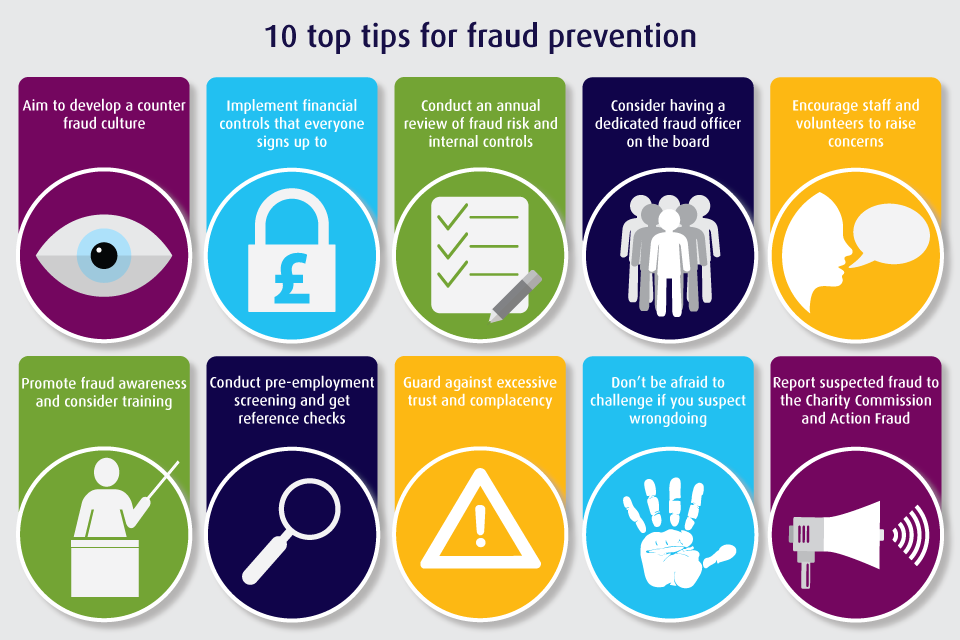
In closing, the Report indicates that it is “vital that charities take appropriate action that is proportionate to their activities, size and financial governance, in order to manage the risk of potential fraud.” The Report also encloses an infographic of “10 top tips for fraud prevention,” together with other recommendations on how charities can avoid insider fraud occurring at their organization. The Charity Commission’s ten top tips are outlined below:
- Aim to develop a counter fraud culture;
- Implement financial controls that everyone signs up to;
- Conduct an annual review of fraud risk and internal controls;
- Consider having a dedicated fraud officer on the board;
- Encourage staff and volunteers to raise concerns;
- Promote fraud awareness and consider training;
- Conduct pre-employment screening and gets reference checks;
- Guard against excessive trust and complacency;
- Don’t be afraid to challenge if you suspect wrongdoing; and
- Report suspected fraud to the Charity Commission and Action Fraud.
Charities and not-for-profits in Canada will find the findings and recommendations of the Charity Commission Report to be a useful resource to help avoid insider fraud occurring within their organizations.
Read the May 2018 Charity & NFP Law Update
by Dev User | May 31, 2018 | Uncategorized
May 2018 Charity & NFP Law Update
On May 10, 2018, the Standing Senate Committee on Social Affairs, Science and Technology (“Standing Committee”) published a report entitled The Federal Role in a Social Finance Fund (the “Report”). The Report follows the Standing Committee’s study of a social finance fund and discussions with the steering group that co-developed a Social Innovation and Social Finance Strategy with the Government of Canada. While the Report was produced in response to an Order of Reference adopted by the Senate on December 14, 2017 authorizing the Standing Committee to “examine and report on issues relating to social affairs, science and technology generally,” it falls in line with the Federal Government’s initiative over the last several years to investigate whether and how to support social finance initiatives in Canada.
The Report describes social finance as “an investment made for the purposes of achieving a beneficial and quantifiable impact on society and/or the environment; and an economic return,” as well as “mobilizing private capital for public good.” While social finance is not a new concept, the Report outlines a more recent phenomenon of social finance being used in the context of social challenges that have been traditionally dealt with by the public sector. In this regard, the Report indicates a need for a financing “ecosystem” to bridge the divide between the need in the charitable and not-for-profit sectors for funds and the supply by impact investors thereof.
The Report also discusses social finance funds in Canada and abroad, and outlines two types of social finance funds. The first model “helps mature social enterprises and charities to expand their programs and to invest in property and real estate or free up equity from real estate or provide subsidies to affordable housing,” and while these are less risky investments, the Report indicates that there are regulatory constraints preventing charities and not-for-profits from investing in them. The second model is the “seed fund model,” which blends philanthropic capital and donations under the assumption that the majority will not grow. However, investors may receive up to 70% of their costs back through a combination of charitable donations and tax credits.
With regard to the role of the government in social finance, the Report states that all witnesses agreed that the government was instrumental in creating, growing and maintaining the sustainability of a social finance market in Canada, both through supporting existing social finance ecosystems and through creating new ones. Witnesses also agreed that the risk for private investors could be reduced through guaranteed government loans.
The Report provides six recommendations concerning what the Federal Government can do to stimulate social investment. These recommendations include that the government: create a pan-Canadian social finance fund operating at arm’s length from the government; seek opportunities to leverage funds from investors when assessing where to invest in the social finance fund; consider using dormant bank accounts as the basis of capital for the social finance fund; target a portion of its social finance fund contribution to intermediary funds used to help marginalized regions and communities; ensure organizations are capable of participating in the social finance ecosystem by supporting institutional capacity building; and make a multi-year commitment to a social finance fund.
While it remains to be seen how the Federal Government will act upon the recommendations, the Report is an encouraging step forward towards creating a more robust social finance model in Canada.
Read the May 2018 Charity & NFP Law Update
by Dev User | May 31, 2018 | Uncategorized
May 2018 Charity & NFP Law Update
Bill C-25 Receives Royal Assent
After being tabled on September 28, 2016, federal Bill C-25, An Act to amend the Canada Business Corporations Act, the Canada Cooperatives Act, the Canada Not-for-profits Corporations Act and the Competition Act (“Bill C-25”) finally received Royal Assent on May 1, 2018. While certain provisions will come into force on a day to be fixed by order of the Governor in Council, the majority of Bill C-25 came into force on Royal Assent. Notwithstanding the breadth of the changes being introduced for Canada Business Corporations Act and co-operative corporations, Bill C-25 includes only minor technical amendments for CNCA corporations. These amendments include a definition of a person who has become “incapable” in subsection 2(1) of the CNCA, and the addition of section 277.1 of the CNCA requiring the Director to publish a notice of any decision made by the Director in respect of applications made under various sections of the CNCA (for example when a corporation is deemed non-soliciting under ss. 2(6), is permitted to delay calling of annual meetings under ss. 160(2), or when the Director relieves the corporation from certain parts of the CNCA under s.173).
New Direct Access to Corporations Canada Examiners for Registered Intermediaries
Corporations Canada announced on May 28, 2018, that registered intermediaries would begin to have better access to Corporations Canada’s examiners. Organizations that frequently file with Corporations Canada on behalf of multiple corporations and that have an established relationship with Corporations Canada can apply to become registered intermediaries. These are usually law firms and corporate service providers. Once registered, they can have increased efficiency in online corporate filing. Starting June 4, 2018, registered intermediaries will have direct access to examiners by phone, via its Contact Centre, for questions that require the specific expertise of an examiner. General inquiries will continue to be handled by the Contact Centre’s information officers.
Read the May 2018 Charity & NFP Law Update
by Dev User | May 31, 2018 | Expertise, Intellectual Property Law
May 2018 Charity & NFP Law Update
In response to the federal government’s commitment through the 2017 Federal Budget to implement reforms to Canada’s intellectual property (“IP”) system, the Minister of Innovation, Science and Economic Development announced the launch of Canada’s Intellectual Property Strategy (the “IP Strategy”) on April 26, 2018. The IP Strategy recognizes that IP helps Canadian innovators attain commercial success and maximize the value of their creations by protecting their ideas, and was designed to “help Canadian entrepreneurs better understand and protect intellectual property…, get better access to shared intellectual property,” and provide businesses with the “information and confidence they need to grow their business and take risks.” In this regard, the IP Strategy states that small and medium-sized businesses that hold formal IP are significantly more likely to engage in product and other innovation, more likely to export, and more likely to be high-growth. As such, the IP Strategy proposes changes in the key areas of legislation, literacy and advice, and tools which are discussed below.
With respect to legislation, the IP Strategy proposes to amend Canadian IP laws to remove barriers to innovation, and in particular to close loopholes for bad faith use of IP, such as trademark squatting and patent trolling. Further, an independent body would be created to oversee patent and trademark agents in order to maintain professional and ethical standards amongst IP professionals.
With respect to literacy and advice, the IP Strategy proposes various educational resources, including the launch of programs through the Canadian Intellectual Property Office to help improve Canadian literacy in IP, providing support to engage with Indigenous people and decision makers, providing support for research activities and capacity building, as well as training federal employees who deal with IP governance.
With regard to tools, the IP Strategy would provide tools to support and educate Canadian businesses about IP, such as the IP Strategy website. Additionally, a “patent collective” will be created to bring businesses together to share expertise and strategy for the purpose of working towards better outcomes for members with regard to IP.
These new measures proposed in the IP Strategy are expected to better facilitate the protection of IP in Canada and will make IP resources available to the public that will be of interest to charities and not-for-profits. In addition to the legislative reforms, charities and not-for-profits should therefore monitor the IP awareness, educational, and strategic growth tools released through the IP Strategy as a means of ensuring that they are protecting and making the best use of their IP.
Read the May 2018 Charity & NFP Law Update
by Dev User | May 31, 2018 | Charity & Not-for-Profit Law, Expertise
Charity & NFP Law Bulletin No. 421, May 31, 2018.